Sedentary lifestyles: How sitting too long affects mobility
Long hours hunched over the wheel, the desk or the television can subtly dampen your body's urge to move, meaning that you might feel less agile or comfortable when standing, walking up and downstairs, bending down or standing up from a long meeting. This is important to consider in the context of joint care for people with sedentary lifestyles.
While sitting itself is not intrinsically harmful, and rest is a vital component of any health and fitness routine, uninterrupted sitting can have negative effects on your musculoskeletal system. Vedist Organic recommends that people incorporate regular movement and breaks in their routine to care for their joints and support mobility.
Why sitting too long can make you stiff
When sitting for long periods of time, your hips and knees are characteristically bent while your ankles, spine and shoulders are held more or less fixed in place, restricting your range of motion and making movement uncomfortable when you need to stand up.
It's not that sitting makes your joints "weak", but that prolonged inactivity decreases your opportunity to move your joints through their full range of motion, increasing stiffness and discomfort. A practical joint care routine should therefore be focused on ensuring that you're not sitting for long uninterrupted periods, rather than on exercises to be done at the end of the day.
How long is "too long"?
It's impossible to say how many hours or minutes of uninterrupted sitting can harm you, since it depends on your profession, age, level of exercise and general activity throughout the day.
In practice, sitting for several hours without getting up in between is not ideal, but it's better to intersperse sitting with regular brief exercise than to sit through an entire day.
Avoid fixing yourself in one position for the entire workday and get up and move, stretch, and loosen your joints occasionally so that movement is a regular part of your day.
Some signs that you need to move more
Your body can give you subtle indications that it needs more exercise and movement in the day. These can include:
-
Stiffness when standing up from a sitting position
-
Tight hips or legs
-
Discomfort when walking after a long period of sitting
-
A general sense of being less limber than usual
-
Difficulty getting up from a sitting position
-
Discomfort following prolonged sitting or driving
These symptoms are not necessarily indicative of a disorder, but if you have persistent, severe or worsening pain or discomfort, you should consult a medical professional.

How sitting can affect different areas
Knees: Prolonged sitting with the knees bent can cause stiffness in that joint for the next few hours or when standing up.
Hips: Sitting has a similar effect on the hips, making walking and other movements uncomfortable after prolonged sitting.
Ankles: Sitting for long periods with your feet in the same position can restrict your movement there, so brief exercises to loosen the joint are a good idea.
Back: Sitting can put additional strain on the muscles in the back, contributing to discomfort and poor posture. This can be alleviated by regular movement and exercise.
Shoulders and neck: Sitting for long periods at a desk or computer can lead to poor posture, which in turn can cause discomfort in these areas. Moving around more and taking regular breaks when working at a computer can help relieve stiffness.
A basic joint care routine for a desk job
A routine doesn't have to be complicated in order to be effective. The most important aspect of a joint care routine is to ensure that you move regularly and have plenty of opportunity to stretch your muscles and move your joints.
Morning mobility
At the beginning of the day take a few minutes to loosen up with some simple stretches or by walking around the house. You'll be able to move your ankles, knees, and shoulders as well as walk around the room.
Breaks during work
Instead of waiting until the end of a lengthy work session (such as a four- or five-hour workday), take regular breaks to loosen your joints. You can do this by walking to the water cooler instead of staying at your desk, making phone calls standing up instead of sitting, and taking short walks during your breaks.
Move the joints that have been still
During a break, use the opportunity to move any joints that have been fixed in one position while sitting, such as the ankles, knees, hips, wrists and shoulders.
Adjust your workstation
A comfortable chair, a desk of suitable height and a computer monitor at eye level can help you stay at your desk for short work sessions without putting undue stress on your body. While these adjustments will not eliminate the need to move, they can help prevent additional strain on your muscles and joints by ensuring that you are sitting comfortably.
Incorporate regular exercise
Taking part in daily exercise and physical activity can improve your mobility and flexibility. Choose an activity that you enjoy and that is suitable for your fitness level. If you have existing pain, inflammation, joint instability or injury, you may need to consult a medical professional before engaging in any new physical activity.
A 60 second movement break
If you have a busy schedule, you can take a very brief movement break. Get up from your desk, loosen your shoulders, roll your ankles and bend and straighten your knees. You don't need to engage in a full-scale workout every time you take a break, but using the 60 seconds to stand up and loosen your joints can make a big difference over the course of an entire day.
The objective of these short breaks is to interrupt your prolonged sitting with regular movement, and they can add up to a substantial opportunity for exercise throughout the day.
Movement, exercise and recovery
One of the most common mistakes is to spend ten hours a day sitting followed by an hour of strenuous exercise. Exercise is a vital component of a joint care routine but everyday movement is just as important.
A balanced approach to joint care incorporates mobility, strength and recovery, because mobility keeps you limber, strength prevents you from injuring yourself during everyday activities, and recovery ensures that your muscles and joints have the opportunity to heal. Vedist Organic's joint health advice is equally focused on these three pillars of health.
Foods, hydration and joint health
Movement is an essential component of joint care, but a healthy diet and proper hydration are integral to your general wellbeing. Eat plenty of fresh produce, whole grains, legumes, nuts and seeds to ensure that your body has the raw materials needed to function correctly. Additionally, drink plenty of water throughout the day to stay well-hydrated.
Rather than eating for a particular nutrient, try to eat a balanced diet that incorporates a variety of foods and minimizes highly-processed and unhealthy options.
If you have a medical condition or particular dietary needs, you should consult a qualified healthcare professional for advice on your diet.

Joint care mistakes to avoid for people who sit all day
It's all too easy to get caught in a cycle of prolonged sitting interspersed with brief, uncomfortable exercises. Here are some common mistakes to avoid:
Sitting without movement breaks throughout the day
Sitting in the same position for too long
Avoiding all physical activity because of stiffness
Beginning a rigorous exercise program directly after sitting for a long period of time
Ignoring swelling or pain
Taking supplements while neglecting movement, sleep and a balanced diet
The aim of joint care is not to eliminate sitting from your day but to strike a balance between sitting, standing, walking, exercising, and sleeping.
A Simple Sitting vs Movement Checklist
|
Daily Habit |
What You Can Do |
Why It Matters |
|
Long desk sessions |
Take regular movement breaks |
Reduces prolonged inactivity |
|
Sitting posture |
Adjust your chair and screen |
Helps maintain a comfortable working position |
|
Stiffness after sitting |
Walk and move gently |
Gets the body moving again |
|
Low daily activity |
Add walking or suitable exercise |
Supports overall mobility |
|
Long driving periods |
Stop safely and move when possible |
Breaks up continuous sitting |
|
Evening routine |
Include light movement instead of remaining seated continuously |
Adds more activity to the day |
|
Recovery |
Prioritize sleep and balanced nutrition |
Supports overall wellbeing |
How to get into the habit of joint care
The biggest obstacle to developing a joint care regimen is consistency. You may find yourself stretching for a few days followed by weeks of little or no exercise. A good way of developing a consistent routine is to tie exercises to events or to the things you do every day.
For instance, you can stand up after finishing a meeting, walk around while making a non-work-related phone call, stand up and move after drinking some water, or simply take a few minutes to walk following an important work task.
This makes joint care less of a chore and more of a regular part of your day.
When to see a doctor
Prolonged sitting can contribute to poor posture, stiffness and discomfort, but it should not be blamed for every ache and pain. Persistent, severe pain or discomfort should be evaluated by a medical professional.
Seek professional advice if you experience any of the following:
-
Swelling or heat around the joint
-
Severe pain
-
An injury
-
Inability to bear weight
-
Loss of mobility or motion
-
Symptoms interfering with your daily life
If you have an existing joint condition, speak with your healthcare professional about the types of exercise and activities that are most suitable for you.
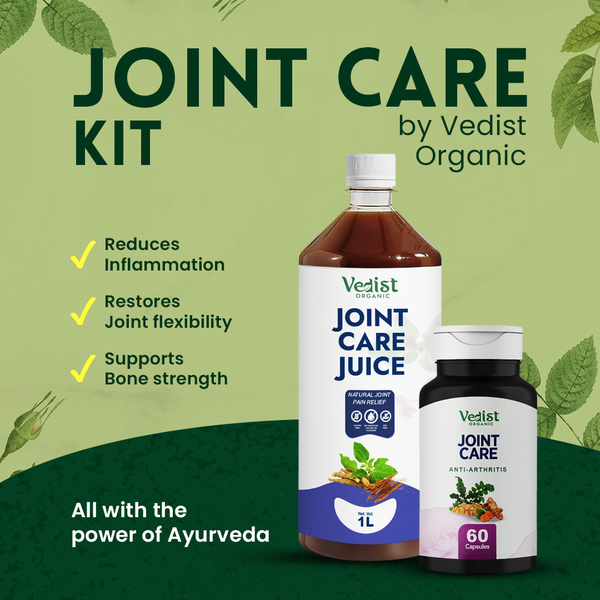
Vedist Organic Joint Care Kit
If you're interested in incorporating an Ayurvedic herbal product as part of a joint care routine, Vedist Organic Joint Care Kit provides Joint Care Juice and Babool Phali Powder. Vedist Organic's Joint Care line is focused on joint health, flexibility and movement, and it recommends that people take a holistic approach to joint care by incorporating exercise, nutrition and sleep in their routine. Vedist Organic states that its Joint Care line uses 100% natural, Ayurvedic ingredients, free from added sugar, artificial colours, and artificial flavours. The Joint Care Kit can be seen as a convenient option to support a joint care routine that includes regular exercise, stretching, nutrition and mobility.
The combination of Joint Care Juice and Babool Phali Powder provides an opportunity for people interested in the Ayurvedic herbal tradition to incorporate these plant-based ingredients into their routine. However, a herbal product should not be used as a substitute for professional healthcare. Anyone taking medication or with an existing medical condition should speak to a qualified healthcare professional before using herbal supplements.

Final thoughts
Long hours of sitting do not have to rule your life. The single most important aspect of a joint care routine for anyone leading a sedentary lifestyle is to take regular breaks and intersperse sitting with regular movement and exercise, and to strengthen and loosen your joints. If you have to sit for your work, begin to take short breaks to stand up and move around and gradually build up to a full exercise routine.